
Who Is the Right Candidate for Knee Replacement Surgery?
Word Summary
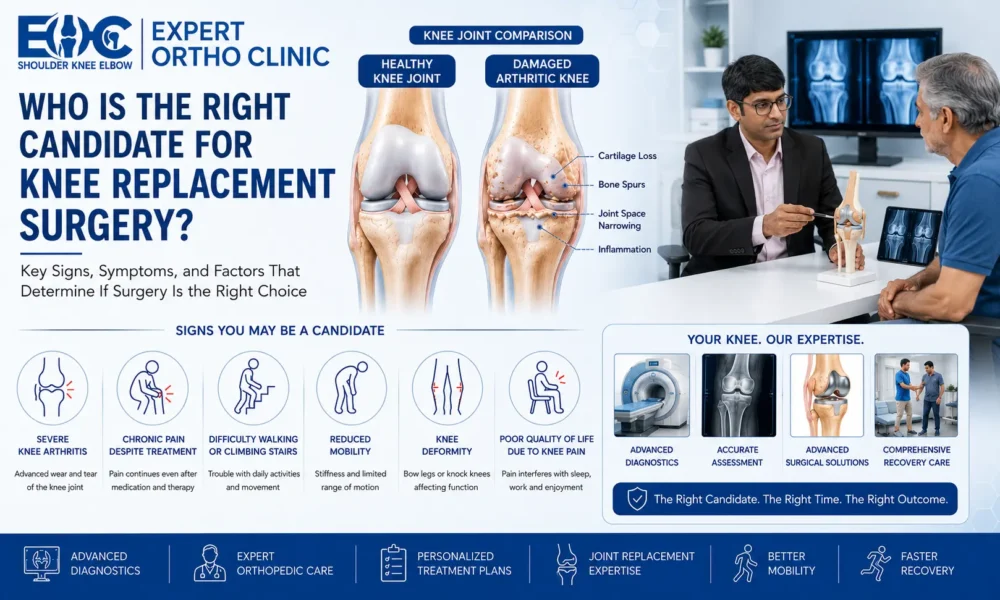
Knee replacement surgery is typically recommended for patients with severe arthritis, persistent pain, stiffness, and reduced mobility that significantly affect daily life and do not improve with conservative treatments such as physiotherapy, medications, or injections. The decision is based on factors like symptom severity, imaging findings, functional limitations, overall health, and quality of life rather than age alone.
Orthopedic specialists also assess whether patients are medically fit for surgery and committed to rehabilitation. Some individuals may benefit from partial knee replacement, while others require total knee replacement depending on the extent of joint damage. Understanding the right timing and candidacy can help patients achieve better pain relief, improved mobility, and long-term functional outcomes.
Key Takeaways
- Severe pain that limits walking, climbing stairs, standing, or sleeping may indicate the need for surgical evaluation.
- Knee replacement is usually considered after non-surgical treatments fail to provide sufficient relief.
- Age alone does not determine eligibility; overall health, function, and joint damage are more important factors.
- Imaging studies such as X-rays help confirm advanced arthritis and cartilage loss but are evaluated alongside symptoms.
- Partial knee replacement may be an option when damage is confined to one compartment of the knee.
- Active participation in physiotherapy and rehabilitation is essential for achieving the best surgical outcomes.
- Optimizing conditions like diabetes control, smoking cessation, and overall fitness can improve recovery and reduce surgical risks.
- The primary goal of knee replacement is to restore mobility, reduce pain, and improve quality of life rather than simply correct imaging abnormalities.
Introduction
Most people do not decide to explore knee replacement surgery after seeing an X-ray. They start looking for answers when simple activities become painful. Walking to the kitchen hurts. Climbing stairs feels exhausting. Standing for long periods becomes difficult. For many patients, the real turning point comes when knee pain begins affecting sleep, independence, and everyday quality of life.
According to the American Academy of Orthopaedic Surgeons (AAOS), knee replacement surgery is one of the most successful orthopedic procedures for relieving pain and restoring function in patients with advanced knee arthritis and severe joint damage. Yet despite its success, not everyone with knee pain is a candidate for surgery.
As Dr. Sanjay Singh, Shoulder and Knee Specialist at Expert Ortho Clinic, explains, “The decision for knee replacement should never be based on age alone. The most important factors are the severity of joint damage, how much the pain affects daily life, the failure of non-surgical treatments, and whether the patient is healthy enough for recovery and rehabilitation.”
Knee replacement surgery is a deal and that is why it is so important to think about who is a good candidate for it. A good candidate for knee replacement surgery usually has a lot of knee pain, has trouble moving around, has pictures of their knee showing that the arthritis is really bad or the cartilage is gone, and is healthy enough for the surgery to be safe. The thing that really matters is not how old you are. What really matters is whether your knee is making it hard for you to move around, be independent and have a life.
In this guide we talk about what orthopedic surgeons look for when they decide if someone is a candidate, the things, about your health that can affect whether you can have the surgery when you might still be able to get help without having surgery and how to figure out if knee replacement surgery is the right thing for you to do next.
Why Choosing the Right Time for Knee Replacement Matters
Many people wait too long before consulting an orthopedic specialist because they assume knee pain is a normal part of aging. Others consider surgery too early before trying effective non surgical treatments.
The best outcomes often happen when surgery is performed at the right stage. If performed too early, patients may not gain enough benefit. If delayed too long, muscle weakness, reduced mobility, joint deformity, and worsening arthritis can make recovery more difficult.
Orthopedic specialists evaluate pain levels, daily function, imaging findings, overall health, and treatment history before recommending knee replacement surgery.
Signs Your Knee May Be Bad Enough for Surgery
Pain That Limits Walking, Stairs, Sleep, or Standing
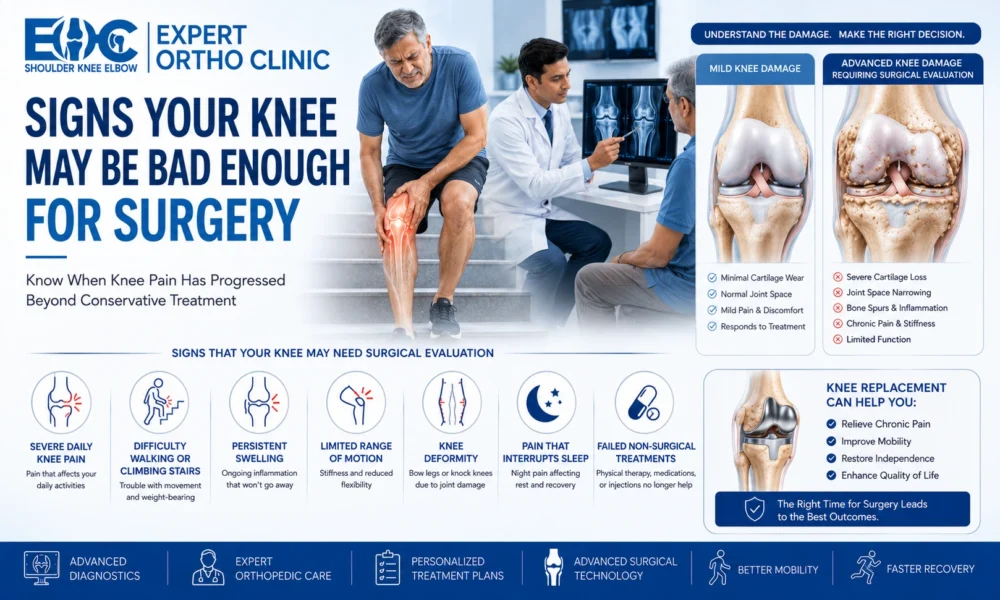
Doctors become concerned when knee pain begins controlling daily activities.
A knee that hurts after a long walk is very different from a knee that hurts while walking around the house, climbing a few stairs, standing in line, or getting out of a chair.
Pain that affects sleep is another important warning sign. Many patients wake up at night because of throbbing knee pain or struggle to find a comfortable sleeping position.
When knee pain begins affecting independence, mobility, work, travel, exercise, and family activities, surgery may become a reasonable option.
Stiffness, Swelling, and Deformity That Do Not Improve
Advanced knee arthritis often causes stiffness that is worst in the morning or after sitting for long periods.
As the condition progresses, stiffness may remain throughout the day. Swelling may become more frequent and stop responding to rest, medication, or ice therapy.
Some patients also notice visible changes in knee alignment. Bow leg deformity, knock knees, reduced knee extension, and difficulty straightening the leg can all suggest significant joint damage.
When the knee loses normal motion and alignment, surgical treatment becomes more likely.
X Rays or Scans Showing Severe Arthritis and Cartilage Loss
Imaging helps confirm what is happening inside the knee joint.
Strong candidates for knee replacement often have:
- Advanced osteoarthritis
- Severe cartilage loss
- Bone on bone arthritis
- Narrowed joint space
- Bone spurs
- Joint deformity
Imaging alone does not determine candidacy. Surgeons look for both severe joint damage and symptoms that significantly affect daily life.
Why Trying Non Surgical Treatment First Matters
Physical Therapy, Medication, Braces, and Injections That Failed
Most patients should explore conservative treatment before considering surgery.
Common options include:
- Physiotherapy
- Anti inflammatory medications
- Weight management
- Knee braces
- Activity modification
- Cortisone injections
- Hyaluronic acid injections
- Strengthening programs
Many patients experience meaningful improvement through these treatments.
However, when symptoms continue despite appropriate non surgical care, knee replacement may become the next logical step.
How Much Relief Is Enough Before Surgery Is Worth Considering

Doctors evaluate more than pain scores.
They assess whether patients can:
- Walk comfortably
- Climb stairs
- Sleep without pain
- Shop independently
- Work normally
- Participate in family activities
- Exercise safely
The goal of knee replacement is not simply reducing pain. The goal is restoring function and improving quality of life.
If daily activities remain significantly restricted despite treatment, surgery may offer greater long term benefit.
Who May Not Be a Candidate Yet?
One of the biggest misconceptions is that every patient with knee pain needs surgery.
Many people are not yet candidates because:
- Arthritis is still mild
- Physical therapy has not been completed
- Weight management has not been addressed
- Symptoms are occasional rather than disabling
- Daily activities remain mostly unaffected
- Joint damage is limited on imaging
In these situations, conservative treatment often remains the best option.
A good orthopedic specialist recommends surgery only when the expected benefits clearly outweigh the risks.
Health Factors Doctors Check Before Recommending Surgery
Age Is Less Important Than Health, Function, and Goals
There is no perfect age for knee replacement surgery.
Some patients in their fifties need surgery because arthritis has become severe.
Some patients in their eighties recover very well because they remain healthy and active.
Modern orthopedic guidelines focus on:
- Pain severity
- Functional limitations
- Joint damage
- Medical fitness
- Recovery goals
Age alone rarely determines candidacy.
Weight, Diabetes, Heart Disease, Smoking, and Infection Risk
Overall health affects surgical safety and recovery.
Doctors often evaluate:
- Diabetes control
- Heart health
- Lung function
- Weight management
- Smoking status
- Infection risk
Poorly controlled diabetes increases infection risk.
Smoking slows healing and recovery.
Certain medical conditions may require optimization before surgery can proceed safely.
Improving overall health before surgery often leads to better long term outcomes.
Partial Knee Replacement vs Total Knee Replacement
Not every patient requires a total knee replacement.
Some people qualify for partial knee replacement if damage is limited to one section of the knee.
| Feature | Partial Knee Replacement | Total Knee Replacement |
| Arthritis Location | One compartment | Multiple compartments |
| Bone Removal | Less | More |
| Recovery | Often faster | Standard recovery |
| Joint Preservation | More natural tissue preserved | Entire joint resurfaced |
| Ideal Candidate | Localized arthritis | Advanced widespread arthritis |
What Experts Look For Before Making the Final Decision
A surgeon does not rely on a single test result.
The final recommendation usually combines:
- Symptoms
- Physical examination
- X rays
- MRI findings when necessary
- Medical history
- Activity level
- Recovery goals
Timing also matters.
Waiting until the knee becomes extremely weak or severely deformed can make recovery more difficult.
The best candidates understand that knee replacement is a process requiring commitment to rehabilitation and long term joint care.
Recovery and Rehabilitation After Knee Replacement Surgery
One topic many patients overlook is recovery.
Successful surgery depends heavily on rehabilitation.
First Week
Patients typically begin walking with assistance shortly after surgery.
The focus is on:
- Pain management
- Swelling reduction
- Early movement exercises
- Walking practice
- Basic physiotherapy
Weeks Two to Six
Most patients gradually improve mobility and confidence.
The focus shifts toward:
- Strength building
- Improved range of motion
- Walking longer distances
- Better balance
- Reduced swelling
Months Two to Six
Patients continue working toward:
- Improved stamina
- Stair climbing
- Daily activity independence
- Long term strength
- Better mobility
Patients who actively participate in physiotherapy often achieve the best results.
A Simple Checklist Patients Can Use Before the Appointment
You may be a strong candidate if:
- Knee pain limits walking, standing, stairs, or sleep
- Swelling and stiffness keep returning
- X rays show advanced arthritis
- Cartilage loss is severe
- Physical therapy did not help enough
- Injections no longer provide relief
- Daily activities are restricted
- Your overall health is stable enough for surgery and rehabilitation
Real Life Examples of Typical Candidates
A Person With Severe Arthritis Who Struggles to Walk
A 68 year old with bone on bone arthritis has tried physiotherapy, injections, medication, and activity modification.
Walking to the mailbox is difficult.
Stairs require support.
Sleep is interrupted by pain.
This patient is often considered a strong candidate for total knee replacement.
A Person With Localized Knee Damage
A 60 year old has arthritis affecting only one compartment of the knee.
Joint motion remains good and ligaments are stable.
This patient may qualify for partial knee replacement instead of total knee replacement.
A Person Who Is Not Yet Ready for Surgery
A 55 year old has mild arthritis and occasional pain after long days.
Sleep remains normal.
Walking is unrestricted.
Physical therapy has not been fully explored.
Most surgeons would recommend additional non surgical treatment before considering knee replacement.
Myths vs Facts About Knee Replacement Surgery
| Myth | Fact |
| Age alone determines candidacy | Overall health and function matter more |
| Every patient with arthritis needs surgery | Many improve with conservative treatment |
| Knee replacement creates a brand new knee | The goal is pain relief and better function |
| Recovery happens automatically | Rehabilitation plays a major role |
| Robotic surgery is necessary for everyone | Suitability depends on the individual patient |
Red Flags That May Delay Surgery
Certain conditions may require treatment before surgery:
- Active infection
- Uncontrolled diabetes
- Smoking
- Severe heart disease
- Poor skin condition around the knee
- Untreated medical problems
Delaying surgery in these situations is often a safety measure rather than a rejection of treatment.
Frequently Asked Questions About Knee Replacement Surgery
1. How do I know if I am a candidate for knee replacement surgery?
You may be a candidate for knee replacement surgery if you have severe knee pain, advanced knee arthritis, significant cartilage loss, persistent knee stiffness, swelling, difficulty walking, trouble climbing stairs, or pain that affects sleep and daily activities. Orthopedic surgeons typically consider your symptoms, X rays, MRI findings, overall health, and response to non surgical treatments before recommending surgery.
2. What is the difference between partial knee replacement and total knee replacement?
A partial knee replacement is usually recommended when arthritis affects only one compartment of the knee and the ligaments remain healthy and stable. A total knee replacement is generally needed when arthritis, cartilage damage, and joint wear affect multiple areas of the knee. Your orthopedic specialist will determine the most suitable option after a detailed evaluation and imaging review.
3. Can knee replacement surgery be avoided with non surgical treatment?
In many cases, yes. Early and moderate knee arthritis may improve with physiotherapy, weight management, knee braces, pain medication, PRP injections, hyaluronic acid injections, strengthening exercises, and lifestyle modifications. However, when severe arthritis, bone on bone knee damage, and loss of function continue despite treatment, knee replacement surgery may provide the best long term solution.
4. How long does recovery take after knee replacement surgery?
Most patients begin walking shortly after surgery with support. Initial recovery typically occurs during the first six weeks, while strength, flexibility, and mobility continue improving over several months. Full recovery depends on factors such as age, fitness level, physiotherapy participation, overall health, and whether a partial knee replacement or total knee replacement was performed.
5. Is robotic knee replacement better than traditional knee replacement surgery?
Robotic knee replacement surgery is a way to get the implant in the right spot. It helps with getting the knee aligned properly and making a plan that is tailored to the patient. This can also lead to balance in the joint. When you compare it to the way of doing things robotic knee replacement surgery seems like a good choice
The truth is, it only works well if the surgeon is very good at what they do. The patient also has to work to get better and that means doing their rehabilitation and physiotherapy. Robotic knee replacement surgery is not a substitute, for a surgeon it just helps them do their job. Robotic knee replacement surgery relies on the surgeon to make it successful. The patient has to be committed to recovering from robotic knee replacement surgery.
6. What are the signs that knee arthritis has become severe enough for surgery?
Common signs include bone on bone arthritis, severe knee pain, chronic swelling, persistent stiffness, reduced range of motion, difficulty standing for long periods, trouble climbing stairs, walking limitations, sleep disruption due to pain, and poor response to physiotherapy, injections, braces, or medication. If knee arthritis is significantly affecting your quality of life, an orthopedic consultation can determine whether knee replacement surgery is appropriate.
About the Author
Dr. Sanjay Singh is a leading orthopedic surgeon and shoulder & knee specialist at Expert Ortho Clinic, South Bombay. He specializes in knee replacement surgery, robotic knee replacement, arthroscopy, sports injury treatment, ACL reconstruction, meniscus injuries, frozen shoulder, and arthritis management.
With a patient-focused approach, Dr. Singh emphasizes accurate diagnosis, personalized treatment plans, and comprehensive rehabilitation to help patients regain mobility, reduce pain, and return to an active lifestyle.
Specialties: Knee Replacement, Robotic Knee Replacement, Shoulder & Knee Arthroscopy, Sports Injuries, Arthritis Treatment, ACL & Meniscus Surgery.
Conclusion
The right candidate for knee replacement surgery usually has advanced knee arthritis, significant pain or stiffness, reduced mobility, and limited relief from non surgical treatment. Successful candidates also have realistic expectations and are prepared to participate fully in rehabilitation.
Knee replacement is not simply about fixing an X ray. It is about restoring independence, improving quality of life, reducing pain, and helping patients return to activities that have become difficult because of severe knee damage.
If knee pain is stopping you from walking, sleeping well, going out often or doing things you love you might want to see a doctor who specializes in bones. They will check your knee, look at some images and talk to you about what you can do to feel better. This will help figure out if knee replacement surgery’s a good idea, for you.
For More Info Contact Us


What is Total Knee Replacement?
Total Knee Replacement (TKR) is a procedure where the damaged knee cartilage is replaced with artificial components to give back.
Read More
Recent Advancements in Knee Replacement Surgery
What is a Knee Replacement Surgery? When the surfaces of the Knee joint are worn out they are removed &.
Read More