
Frozen Shoulder Treatment Without Surgery: Does It Actually Work?

Summary
Frozen shoulder feels scary when you first hear the term, but here’s the honest picture: most people never need surgery to fix it. The stiffness builds up gradually as the capsule around your shoulder joint tightens, moves through three predictable stages, and in the vast majority of cases, responds well to physiotherapy, medication, and targeted injections like corticosteroids or hydrodilatation. Left untreated, it can drag on for one to three years, but with the right care, most patients see real improvement within months.
Surgery only comes into the picture for a small number of patients who’ve genuinely given conservative treatment a fair shot and still aren’t improving. Dr. Sanjay Singh, a fellowship-trained shoulder and knee surgeon with over 1000 surgeries to his name, takes a non-surgical-first approach with nearly every frozen shoulder patient who walks into Expert Ortho Clinic – and that clinical judgment, backed by real outcomes data, is exactly why this condition doesn’t need to feel as intimidating as it sounds.
Key Takeaways
- Surgery is rarely the first answer. Most frozen shoulder cases improve fully with non-surgical treatment, and even Dr. Singh, a practicing shoulder surgeon, doesn’t push surgery unless conservative care has genuinely failed.
- It’s not the same as a rotator cuff tear. Frozen shoulder is mainly about stiffness, not weakness, and doctors check this by seeing if you lose range of motion even when someone else moves your arm for you.
- Diabetes raises your risk significantly, especially relevant in India given how common it is here. Keeping blood sugar under control genuinely supports shoulder recovery too.
- It moves through three stages – freezing, frozen, and thawing – each with its own timeline, so knowing which stage you’re in helps set realistic expectations.
- Untreated, it can take one to three years to resolve on its own. With proper treatment, most patients see real improvement in just a few months.
- The evidence backs non-surgical care strongly – studies show fewer than one in five patients still have lingering symptoms after proper conservative treatment.
- Physiotherapy is the single most effective tool, especially hands-on techniques like Maitland mobilization combined with targeted stretching.
- Hydrodilatation is a lesser-known but effective option – an ultrasound-guided procedure that physically stretches the tight capsule, with many patients feeling looser within days.
- Gentle exercises like the pendulum stretch can start early, but pushing too hard too soon can actually set your recovery back.
- Getting evaluated by a specialist early shortens the whole journey. Dr. Sanjay Singh, fellowship-trained in shoulder and elbow surgery in Italy with 500+ surgeries performed, offers a free MRI review over WhatsApp (7400355815) before your first appointment, so you get expert clarity before you even walk in.
Introduction
If your doctor just told you that you have a frozen shoulder, there’s probably one question sitting at the top of your mind: am I going to need surgery? I’ll give you the short answer first. Most people don’t. Frozen shoulder, or adhesive capsulitis as we call it medically, gets better on its own steam in the majority of cases once you start proper non-surgical treatment. Surgery only comes up for a small slice of patients who simply don’t respond to conservative care.
I’ve done hundreds of shoulder procedures over my career, and even so, I tell most of my frozen shoulder patients the exact same thing on day one: let’s see if we can fix this without cutting anything open. So in this piece, I want to walk you through what non-surgical treatment actually looks like in practice, why it works for so many people, and where the line is for when surgery genuinely makes sense.
What Is a Frozen Shoulder, Really?
Think of your shoulder joint as sitting inside a capsule of connective tissue, one that keeps everything stable while still letting you move your arm freely in almost any direction. With a frozen shoulder, that capsule gets inflamed, and over time it thickens and pulls tighter around the joint. As it shrinks, your arm simply can’t go as far as it used to, and things you never thought twice about, like reaching for a seatbelt or combing your hair, suddenly hurt.
People mix this up with a rotator cuff tear all the time, so let’s sort that out. A torn rotator cuff is damage to the tendons that actually move your shoulder, and it usually comes with weakness on top of the pain. A frozen shoulder is a different animal. It’s really about stiffness above everything else. You’ll notice you can’t move your arm through its full range even when someone else tries to move it for you, and that specific detail is one of the first things a doctor checks for during an exam.
There’s also this small, fluid-filled cushion near the joint called the bursa, and its job is to reduce friction between bone and soft tissue. Bursitis can produce pain that feels a lot like frozen shoulder, but it’s a completely separate condition, and the treatment isn’t the same either.
Why Does Frozen Shoulder Happen in the First Place?
Truthfully, in most patients, we can’t nail down one single cause. That’s why doctors often call it idiopathic frozen shoulder, which is just a fancy way of saying we don’t fully know why. Still, a few things clearly push your risk up.
Diabetes is right at the top of that list, and it’s a big deal for patients here in India given how common diabetes already is in this country. High blood sugar changes the connective tissue around your joints, making it stiffer and more likely to inflame. So if you’re diabetic and dealing with a frozen shoulder right now, keeping your sugar levels in check isn’t just about your general health. It actually supports your shoulder healing too.
Thyroid problems are another trigger we see often. So is any long stretch where your shoulder hasn’t moved much, maybe after a surgery, after a stroke, or even just from wearing a sling for something unrelated. The moment a joint stops moving the way it’s supposed to, the tissue around it starts tightening up on its own.
Catching the Symptoms Early
Frozen shoulder rarely announces itself loudly. It usually starts as a dull ache when you reach overhead, or maybe when you lie on that side at night. Then, slowly, the pain sharpens and your range of motion starts shrinking bit by bit. Ordinary things get harder without you even realizing it at first: zipping up a dress from behind, grabbing something off a top shelf, scratching an itch on your own back.
Catch it early, and your recovery is almost always shorter and easier. Ignore it, and the frozen stage tends to drag on far longer than it needs to.
The Three Stages Every Patient Should Understand
A frozen shoulder doesn’t appear overnight, and it definitely doesn’t leave overnight. It moves through three stages, and once you know them, you’ll have a much better sense of where you stand at any given point.
First comes the freezing stage, where pain builds gradually and mobility starts slipping away. This one usually runs anywhere from six weeks up to nine months.
Next is the frozen stage. Oddly enough, the pain often calms down a bit here, but the stiffness takes full control. Your shoulder feels locked in place, and everyday life gets genuinely tough. This stage can last four to twelve months.
Finally, there’s the thawing stage, your actual recovery period. Movement gradually comes back, and whatever pain is left keeps fading. Depending on how early you started treatment and how consistent you were, this can take anywhere from several months up to a couple of years.
Leave a frozen shoulder completely alone, and it can take one to three years to sort itself out. Get proper treatment going, though, and most patients see real improvement in months, not years.
Does Non-Surgical Treatment Actually Work?

Yes, and I’m not saying that just to make you feel better. The outcomes back it up. Research following patients through conservative treatment found that fewer than one in five still had lingering symptoms afterward. That’s a strong number. It means physiotherapy, medication, and the right injections are enough to fully restore function for most people who stick with the plan.
Here’s something you might not expect to hear from someone who operates on shoulders for a living: I don’t push surgery for most frozen shoulder cases. The evidence doesn’t support jumping straight to an operation when conservative care works this well for this many people. Surgery brings its own set of risks, and nothing in current research shows it beating proper non-surgical treatment on long-term outcomes for most patients. I only bring surgery into the conversation once someone has genuinely given the non-surgical route a real chance and it still isn’t working.
Your Non-Surgical Treatment Options, One by One
There’s no single fix that works for everyone. What actually helps is usually a mix of these, adjusted to whichever stage you’re in right now.
Physiotherapy and manual therapy sit at the center of treatment. A physiotherapist uses hands-on techniques, including something called Maitland mobilization, to gently move the joint and loosen up the stiffness. Combined with the right stretching, this is still the single most effective non-surgical way to get your range of motion back.
Medications take the edge off pain and inflammation, especially early on. Regular over-the-counter anti-inflammatories like ibuprofen help, and your doctor can prescribe something stronger if needed. On their own, medications won’t undo the stiffness, but they make physiotherapy far more bearable.
Corticosteroid injections are one of the strongest tools we have for pain relief, particularly in the earlier stages. Your doctor injects an anti-inflammatory dose straight into the joint, and for a lot of patients, that brings the pain down enough to make physiotherapy actually possible.
Hydrodilatation doesn’t get talked about much, so let me actually explain it properly. Your doctor injects a mix of saline, a steroid, and sometimes a local anaesthetic straight into the tight capsule, which physically stretches it from within. It’s guided by ultrasound, so your doctor can see exactly where the needle is going in real time, which makes the whole thing both safer and more accurate. Plenty of patients feel noticeably looser within just a few days of this.
PRP injections, short for platelet-rich plasma, are a newer option built around your body’s own healing process. Your doctor draws your blood, concentrates the healing platelets in it, then injects that back into the joint to support tissue repair. It’s not something we reach for first, but it’s worth bringing up with your doctor if the standard treatments have stalled.
Supportive therapies, things like ultrasound therapy, alternating hot and cold packs, and kinesiotaping, won’t cure a frozen shoulder by themselves. But they do help you manage the day-to-day discomfort while the real treatment does its work.
Frozen Shoulder Exercises to be start only when pain settles
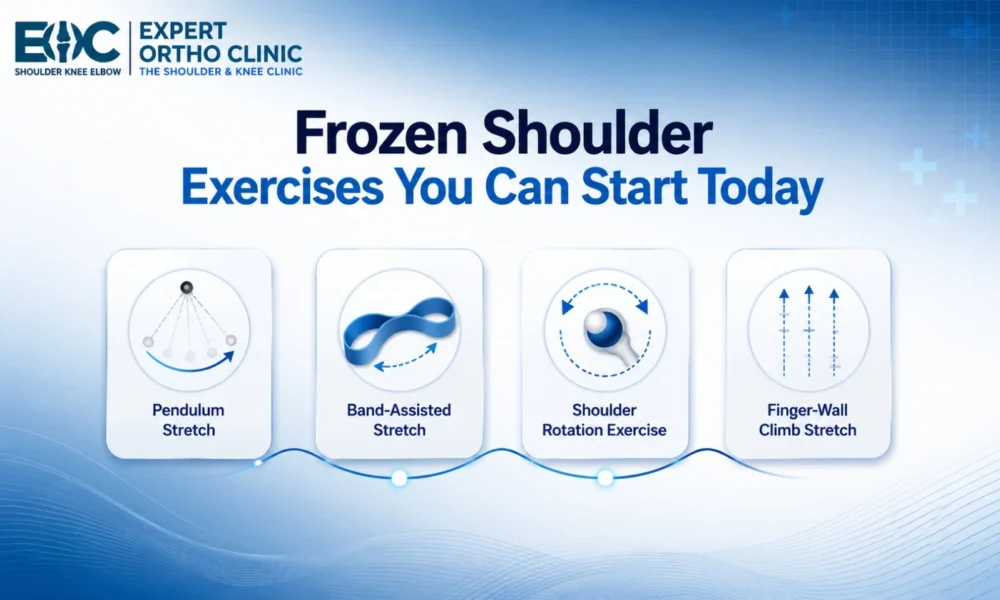
Movement genuinely helps here, but it is not to be done initially especially while you’re still in that painful freezing stage. Push too hard, too soon, and you can undo weeks of progress.
Start with the pendulum exercise. Lean forward a little, let your affected arm hang loose, and rest your other hand on a table or chair for support. Swing your arm in small, easy circles and let gravity handle the movement instead of forcing it yourself.
Once the sharp pain calms down, you can add isometric exercises. Stand near a wall, bend your elbow to about 90 degrees, and press the back of your wrist gently against the wall without letting your arm actually move. Hold that for five seconds, then let go. This strengthens the muscles around the joint without putting stress on the tight capsule.
Simple shoulder rolls and shoulder blade squeezes help too, keeping the surrounding muscles active while everything else heals underneath.
One thing worth mentioning if you’re in India: everyday movements like riding a two-wheeler, reaching behind yourself while draping a saree, or standing at the stove cooking for a long time all put real strain on your shoulder, and most generic exercise guides never account for this. Pay attention to these during your recovery, and don’t be afraid to modify how you do them until your movement improves.
You can watch these exercises performed correctly in our video guide, and always run any increase in intensity past your physiotherapist first.
When Non-Surgical Treatment Isn’t Enough
Most people recover just fine without surgery, but I’d rather be upfront about when conservative treatment has reached its limit. If you’ve put in several months of proper physiotherapy along with the right injections and your shoulder still hasn’t regained meaningful movement, it’s fair to start talking through other options with your surgeon.
At that point, two procedures usually come up. Manipulation under anesthesia is where your surgeon moves your shoulder through its full range while you’re under anaesthesia, which breaks up the tightened tissue inside. Arthroscopic capsular release is a keyhole surgery where the surgeon precisely cuts through the tightened parts of the capsule using small instruments. Both need general anaesthesia, and I only bring either of them up once conservative treatment has genuinely had its fair chance.
None of this is meant to make surgery feel inevitable. I just want you walking in with a clear, honest picture of what your next step would actually look like, so nothing ever catches you off guard.
How to Sleep With a Frozen Shoulder
If there’s one part of frozen shoulder that catches patients off guard, it’s the nights. In my clinic, I hear this complaint almost more than any other: the shoulder feels manageable during the day, but the moment you lie down, the pain flares up and sleep becomes a real struggle. There’s actually a reason for this. Once you’re lying flat, gravity pulls on the inflamed capsule differently than it does when you’re upright, and that’s often what makes night pain feel worse than anything you feel during the day.
The good news is a few simple adjustments can make a real difference. Try sleeping on your unaffected side, and tuck a pillow under your affected arm so it’s properly supported rather than just resting on the mattress. If flat feels too uncomfortable, prop yourself up in a slightly reclined position with a couple of extra pillows behind you, since that takes some of the direct pressure off the joint. And as tempting as it might be to just settle onto the sore side out of habit, try to avoid lying directly on the painful shoulder until things start easing up.
I always tell my patients this isn’t a permanent fix, just a way to get through the tougher nights while the actual treatment does its job. If night pain is still keeping you up regularly despite trying these adjustments, that’s worth mentioning at your next visit, since it usually means your treatment plan needs a small tweak.
How Long Does Recovery Actually Take?
This is probably the question I get asked the most, and honestly, there’s no single answer that fits everyone. It really comes down to two things: how early you start treatment, and how consistently you stick with it. Those two factors matter more than almost anything else in this recovery.
Left completely untreated, a frozen shoulder can drag on anywhere from one to three years. That’s a long time to live with pain and stiffness that could genuinely be shortened. But with structured physiotherapy and the right mix of treatments, most of my patients start noticing real improvement within three to six months, and the gains keep building from there as they move into the thawing stage.
Here’s something I tell every patient early on: consistency beats intensity, every single time. A gentle, steady routine that you actually stick with will always get you further than occasional bursts of pushing too hard, hoping to speed things up. I’ve seen patients try to rush their own recovery by overdoing exercises on a good day, only to end up in more pain and losing the progress they’d already made. Slow and steady genuinely wins this one.
If you’re a few months into treatment and not seeing the movement you’d expect, don’t just wait it out silently. Bring it up at your next appointment. Sometimes recovery just needs a small adjustment to the plan, and catching that early makes a real difference to how the rest of your timeline plays out.
What Does Treatment Cost in Mumbai?
I get this question almost every single day, and it’s a fair one. Nobody wants to walk into treatment without some sense of what to expect financially, so let me give you an honest, practical breakdown rather than vague numbers.
Costs really do shift depending on your specific case and how many sessions or procedures you end up needing, but here’s a rough sense of what most of my patients see. Physiotherapy sessions generally fall somewhere between a few hundred and a couple of thousand rupees each, and where you land in that range depends on the clinic and whether you’re going in-person or booking a home visit. A steroid injection is usually a one-time cost of a few thousand rupees. Hydrodilatation runs a bit higher than a standard injection since it’s an ultrasound-guided procedure that needs more precision and equipment, but even then, it’s nowhere close to what surgery would cost you.
I say this to every patient, and I mean it genuinely: the numbers above are just to give you a ballpark so you’re not walking in blind. Your actual treatment plan and the exact costs involved should always come from a direct conversation with your doctor, based on your specific case, your stage of frozen shoulder, and how you’re responding along the way. I’d rather you ask me directly and get a clear answer than guess based on averages that may not apply to you at all.
If cost is a concern that’s holding you back from starting treatment, tell your doctor that upfront. Most treatment plans can be sequenced or adjusted in a way that works with your budget without compromising your recovery.
Myths vs Facts About Frozen Shoulder
Myth: Cold weather causes frozen shoulders. Fact: There’s no real evidence that weather is a cause, though some people do notice their symptoms feel worse in colder months simply because muscles get stiffer in general.
Myth: Surgery gets you better faster than conservative treatment. Fact: Current evidence doesn’t show surgery beating proper non-surgical treatment on long-term results for most patients, and it comes with extra risks and its own recovery period on top.
Myth: It’ll go away on its own without you doing anything. Fact: Technically, yes, a frozen shoulder can resolve itself untreated, but it often takes years and can leave lingering stiffness behind. Proper treatment shortens that timeline considerably and gets you a better final range of motion.
Myth: Home remedies alone can fix it. Fact: Heat packs and rest ease discomfort, sure, but they don’t touch the underlying capsule tightening. You need medicine initially to cut down the pain & then actual movement-based treatment to get real function back.
Frequently Asked Questions
Can frozen shoulders be cured without surgery?
Yes. Most patients recover fully through physiotherapy, medication, and injections, and never need surgery at all.
Is frozen shoulder permanent if left untreated?
Usually not, but untreated cases can take one to three years to resolve, and some residual stiffness can stick around.
What happens if the frozen shoulder is left completely untreated?
The stiffness and pain generally get worse before they slowly ease up on their own, and the whole process takes noticeably longer than it would with proper treatment.
How long does frozen shoulder last without any treatment?
Somewhere between one and three years, depending on the person.
What’s the best exercise for frozen shoulder relief?
The pendulum exercise is one of the gentlest, most effective places to start, especially while you’re still in that early, painful phase.
Is hydrodilatation painful?
Most patients handle it well since a local anaesthetic is used, and a lot of them feel noticeably looser within just a few days afterward.
Does diabetes make frozen shoulders worse?
Yes. It raises your risk of getting a frozen shoulder in the first place, and it can slow your recovery too, which is exactly why keeping your blood sugar in check matters so much through treatment.
When to See a Shoulder Specialist
A question I hear a lot is, “How do I know when it’s actually time to see someone about this, versus just waiting it out a bit longer?” Fair question, and here’s my honest answer.
If your shoulder pain has stuck around for more than a few weeks, that’s usually your signal. It’s not something you need to push through on your own with heat packs and hope. And if you’re noticing your range of motion getting worse instead of better, that’s an even clearer sign that something structural is going on and it deserves a proper look rather than guesswork.
I understand the instinct to wait it out. A lot of my patients tell me they figured it would just settle down on its own, and by the time they came in, months had already passed and the stiffness had set in far more than it needed to. That’s the part that genuinely bothers me as a surgeon, not because surgery becomes more likely, but because the non-surgical treatment that works so well early on becomes a longer, harder road the longer you wait.
Getting a proper diagnosis early doesn’t commit you to anything. It just gives you clarity on what’s actually happening in your shoulder and the fastest, gentlest path back to full movement. So if this sounds like where you’re at right now, don’t wait for it to get worse before you act on it.
About the Author
Dr. Sanjay Singh is a fellowship-trained orthopaedic surgeon specializing in shoulder, elbow, and knee care, and practices at Expert Ortho Clinic with OPDs in Chembur and Ghatkopar, South Mumbai. He completed his basic orthopedic training at the prestigious PGIMS, Rohtak, followed by his DNB in Mumbai. During his residency, he developed a strong interest in arthroscopic (keyhole) shoulder and knee surgery, and went on to work as a Registrar at TNMC & Nair Hospital, where he sharpened his surgical skills further.
To pursue his interest in arthroscopy, Dr. Singh travelled to Italy for specialized fellowship training in shoulder and elbow surgery, working alongside a team of highly skilled specialist surgeons in Europe and gaining deep experience in managing complex shoulder and elbow conditions. He has also served as a Sports Medicine Consultant at Max Super Speciality Hospital, Mohali, where he treated professional athletes across multiple sports.
Overall, Dr. Singh has performed more than 1000 surgeries, including shoulder arthroscopy, shoulder arthroplasty (replacement), knee arthroscopy, and other complex shoulder and elbow procedures. Beyond surgery, he places strong emphasis on complete patient evaluation, identifying and correcting shoulder or knee issues caused by faulty posture and movement habits, and relies on a rehab and muscle re-education based approach for many common conditions, often resolving them without surgery at all.
Conclusion
If there’s one thing I want you to walk away with after reading all of this, it’s a sense of relief rather than worry. A frozen shoulder feels alarming when you first get the diagnosis, especially with all the stories you might hear about surgery and long recoveries, but the reality is far more reassuring. Most of my patients get their full range of motion back through physiotherapy, medication, and the right injections, without ever needing an operation. Surgery stays on the table only for the small number of cases where conservative treatment has genuinely been given a real chance and still isn’t enough.
What actually makes the difference isn’t some rare, expensive treatment. It’s starting early, staying consistent, and working with someone who can adjust your plan as your shoulder responds. That’s the part patients underestimate the most. A frozen shoulder that’s caught and treated properly in its early stages behaves very differently from one that’s left to sit for months.
I’ve spent years treating shoulders, and if there’s one piece of clinical judgment I trust above almost anything else, it’s this: give your body a real chance to heal the non-surgical way before assuming surgery is your only option. The evidence supports it, and so does what I see in my own clinic week after week.
If your shoulder pain has been sticking around for a while, or you’re just not sure whether what you’re feeling is a frozen shoulder or something else entirely, don’t sit on it. Come in for a proper evaluation.
For More Info Contact us

A dislocating shoulder in an Athlete
I Dislocated my Shoulder 6 months back during a Kabbadi match & it has dislocated again twice since then, what’s the.
Read More
Preventing Cuff tears Strategis for Shoulder.
What is the rotator cuff in the shoulder? Rotator cuff is a group of four muscles which control the stability.
Read More