
Knee Replacement Recovery Timeline: Week by Week Guide
Summary
Knee replacement recovery isn’t a straight line phenomenon – it’s a slow, uneven process with a genuinely hard first two weeks, steady gains through six weeks to three months, and a “mostly recovered” feeling that settles in over six months to a year. Early movement, consistent physiotherapy, and realistic expectations make the biggest difference in outcomes. Beyond the one-year mark, most patients live normally with their implant for 20+ years, though some experience permanent clicking sounds or lasting difficulty with deep kneeling and squatting – neither of which signals a problem. Daily-life specifics like stairs in older buildings, commuting on local trains, floor-sitting, and monsoon-related stiffness matter just as much as the clinical milestones. Emotional ups and downs, including doubt in the early weeks, are a normal part of the journey rather than a warning sign.
Key Takeaways
- Recovery isn’t linear – expect good days and bad days, even within the same week.
- Weeks 1–2 are the hardest, largely due to disrupted sleep and the discomfort of early physiotherapy, not lack of progress.
- Early movement matters – standing and taking a few steps within 24 hours of surgery speeds up the whole recovery.
- Skipping physiotherapy has real consequences – it can lead to stiffness requiring manipulation under anesthesia or arthrolysis to fix.
- Numbness near the incision is normal and usually fades over months, though a small patch can linger longer for some.
- Daily-life milestones matter as much as clinical ones – stairs, driving, commuting, floor-sitting, and squatting all follow their own timelines.
- Diet supports healing – protein, calcium, and anti-inflammatory foods make a measurable difference in recovery quality.
- Full recovery takes up to a year, though most patients feel largely like themselves by three to six months.
- Some effects are permanent – clicking sounds and difficulty kneeling can persist for years without indicating a problem.
- Implants last 20+ years on average, but revision surgery or a second knee replacement is a realistic possibility worth understanding, not fearing.
Introduction
If you’ve been searching for what recovery after knee replacement really feels like, you’ve probably noticed something: most articles give you the textbook version – clean timelines, reassuring percentages, and stock photos of smiling people walking in parks by week six. That’s not the whole story.
Recovery is real, it’s slow in parts, and it looks different depending on where you live. Managing swelling in a Mumbai apartment with no lift is a different experience than doing it in a ground-floor bungalow abroad. Sitting for meals on the floor, using an Indian toilet, or catching the local train back to work – these aren’t details you’ll find in guides written for a different country. This guide covers the week-by-week reality, the parts nobody tells you, and what life actually looks like years down the line, not just at the twelve-month mark where most articles stop.
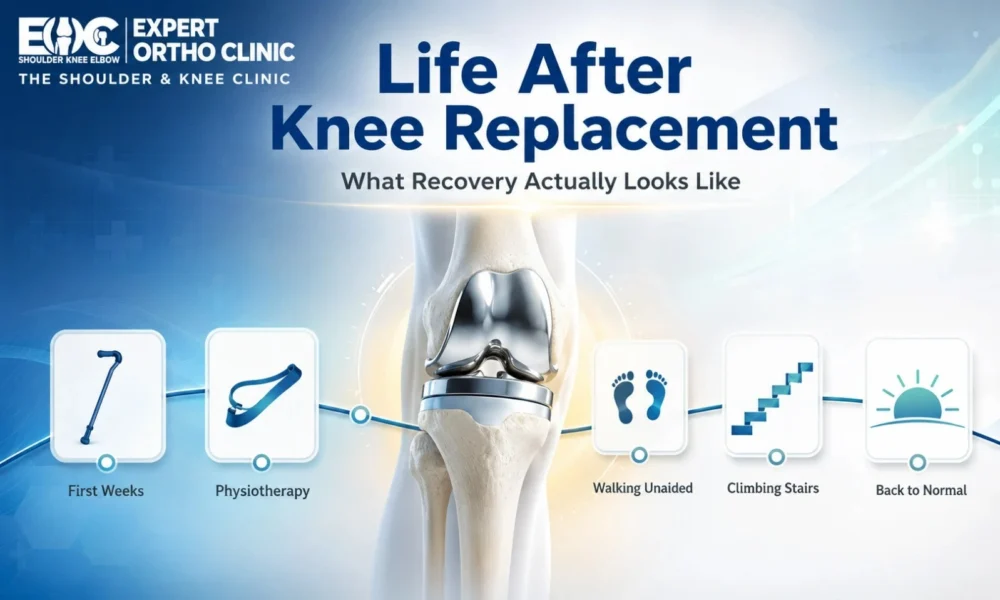
Life After Knee Replacement: What Recovery Actually Looks Like
If you’ve been searching for what recovery after knee replacement really feels like, you’ve probably noticed something. Most articles give you the textbook version. Clean timelines. Reassuring percentages. Stock photos of smiling people walking in parks by week six.
That’s not the whole story.
Recovery after knee replacement is real, it’s slow in parts, and it looks different depending on where you live. Managing swelling in an apartment with no lift in Ghatkopar is a different experience than doing it in a ground-floor bungalow in the suburbs. Sitting for a meal on the floor, using a squat toilet, or catching the local train back to work – these aren’t details you’ll find in most guides written for a different country.
I’m Dr. Sanjay Singh, an orthopedic and sports injury specialist at Expert Ortho Clinic in Mumbai, with clinics in South Bombay, Chembur, and Ghatkopar. I’ve walked hundreds of patients through this exact recovery, and this guide is the version I actually tell them – week by week, including the hard parts, and what life looks like years down the line, not just at the twelve-month mark where most articles stop.
What Knee Replacement Recovery Really Involves
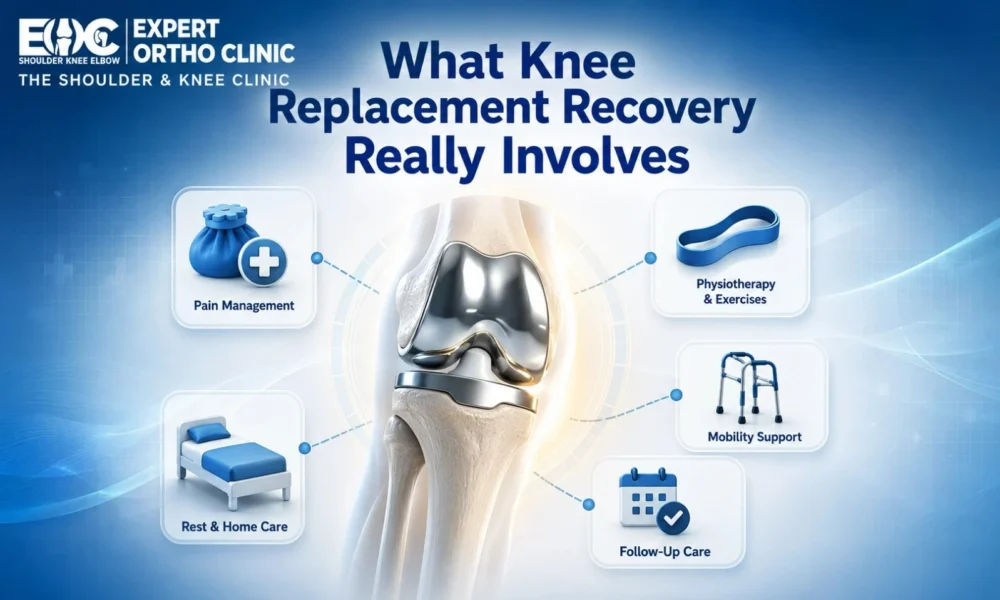
A total knee replacement, or total knee arthroplasty, means replacing the damaged surfaces of your knee joint with a prosthetic implant – a femoral component on the thigh bone side, a tibial component on the shin bone side, and a polyethylene liner that sits between them and acts like cartilage. It sounds mechanical because it is. But the goal is simple: get you moving without the pain that’s been holding you back.
Here’s the first thing to accept: recovery isn’t a straight line. You won’t feel steadily better every single day. You’ll have days where you walk further than expected, followed by days where your knee feels stiff and cranky for no clear reason. That’s normal, not a setback.
The numbers are genuinely encouraging, though. Most patients experience substantial pain relief and much better function after surgery, and a well-placed implant can last well beyond 20 years with good care. Keep that in mind on the harder days – you’re not chasing a small improvement, you’re rebuilding a joint that should serve you for decades.
Day 1 to 3: Right After Surgery
Most patients stay in the hospital for a few days after surgery, sometimes less with modern techniques. The procedure itself is usually done under spinal anesthesia combined with a regional nerve block, which numbs the leg and keeps you far more comfortable in those first critical hours.
Here’s something that surprises a lot of patients: you’ll likely be asked to stand and take a few steps within 24 hours of surgery, with support. It sounds too soon, but early movement is one of the biggest factors in a smooth recovery. It reduces stiffness, helps circulation, and gets your muscles working again before they have a chance to weaken.
The swelling and pain you feel aren’t signs something’s wrong – they’re your body doing exactly what it would do after any injury. Your body genuinely can’t tell the difference between surgery and trauma, so it sends fluid and inflammatory cells straight to the knee to start healing it. That’s why the leg looks swollen and feels heavy in these first days. It’s expected.
If insurance is on your mind, most Mumbai hospitals work with cashless mediclaim processes for knee replacement, but it’s worth confirming the paperwork and pre-authorization with your hospital’s insurance desk before the day of surgery, so nothing holds up your discharge.
Week 1 to 2: The Hardest Stretch
I’ll be honest with you about this part, because most sources aren’t.
Weeks one and two are the toughest stretch of the entire recovery. Physiotherapy usually starts within a day of surgery, and it’s uncomfortable – not because anything’s going wrong, but because you’re asking a freshly operated joint to bend and straighten on command. Expect real effort here.
The single complaint I hear most from patients in this window isn’t pain during the day. It’s sleep. Between the swelling, the awkward positioning needed to keep the leg elevated, and pain medication that can leave you groggy without actually helping you sleep well, this is often the roughest part of the whole journey. If this happens to you, know that it’s common, it’s temporary, and it gets dramatically better after the second week.
You’ll also notice some numbness around your incision. This happens because tiny nerve endings near the skin get disrupted during surgery – it’s not a complication, and for most patients it fades gradually over several months, though a small patch of numbness near the scar can linger longer for some. Bruising and swelling are also completely normal here and usually peak around this time before starting to settle.
You’ll be moving from a walker to a cane as your confidence and strength improve, usually somewhere in this window or shortly after. And please don’t be hard on yourself if you have a genuinely bad day where you wonder if this was the right decision. Almost everyone I’ve treated has had that thought somewhere between week one and two. It passes.
One patient of mine, Aanchal Pawar, told me what helped her most in this stretch wasn’t the medication – it was having someone explain clearly what to expect and why. She’s mentioned how much it mattered to have her concerns actually listened to rather than rushed through. That’s exactly the point of being upfront with you here.
One thing to genuinely watch for: sudden calf pain, swelling, or redness in the leg can be a sign of a blood clot (deep vein thrombosis). It’s uncommon, but if you notice it, call your surgeon immediately rather than waiting it out.
Week 3 to 6: Regaining Control
This is where things start to shift in your favor.
Your physiotherapist will be pushing you toward specific range-of-motion targets, generally aiming for your knee to bend to around 110 to 115 degrees and straighten fully. This isn’t an arbitrary number – it’s the flexion you need for basic daily activities like getting into a car, climbing stairs, or standing up from a low chair.
Here’s something worth knowing plainly: if you skip physiotherapy sessions or don’t keep up with your home exercises, your knee can stiffen up with scar tissue, and you may need a procedure called manipulation under anesthesia, or in more established cases, a minor surgery called arthrolysis, to regain the motion you lost. Neither is common if you stay consistent with your exercises, but it’s a real consequence worth understanding rather than glossing over.
Climbing stairs deserves special mention if you live in one of Mumbai’s older buildings without a lift. The general rule is “up with the good leg, down with the operated leg” until your strength catches up, and a good physiotherapist will walk you through this specifically for your building’s layout. If stairs are unavoidable daily, mention this to your surgeon early – it can shape how your rehab plan is paced.
Driving typically becomes possible somewhere in this window, generally once you’re off strong pain medication and have good control and reflexes in the leg. If your right knee was operated on and you drive an automatic, this may take a little longer than if it’s your left knee or a manual transmission car where your right leg does less of the work.
6 Weeks to 3 Months: Back Into Daily Life
By six weeks, most patients feel noticeably more like themselves.
Return to work depends heavily on what you do for a living. If you have a desk job, you might be back within a month or so. If your work involves standing for long hours, physical labor, or a lot of walking, it’s realistic to expect several months before you’re fully comfortable.
For Mumbai commuters, local trains, autos, and two-wheelers all come with their own considerations. Crowded trains and the quick pace needed to board and alight aren’t ideal in the early weeks – give yourself extra buffer time, avoid rush hour if you can, and don’t hesitate to ask for a seat near the door. Two-wheelers require good knee flexion to mount and dismount safely, so this usually comes later than car travel.
Sitting cross-legged, squatting, or sitting on the floor for meals or prayer are questions I get asked constantly, and for good reason – these are everyday realities in most Indian homes. The honest answer is that these positions ask for far more knee flexion than walking or climbing stairs, and many patients find full cross-legged sitting or deep squatting genuinely difficult even well after “recovery” is considered complete. Some regain enough flexibility to manage it comfortably; others find a modified position, like sitting on a low stool instead of the floor, works better long-term. It varies by implant type and individual healing, so this is worth discussing directly with your surgeon rather than assuming either outcome.
Diet matters more than people expect. A recovery-friendly plate doesn’t need to be complicated – good protein sources like dal, eggs, paneer, and fish support tissue healing, while calcium from dairy and leafy greens supports bone health around the implant. Anti-inflammatory foods like turmeric, ginger, and fresh fruit are worth including regularly, and staying well hydrated helps manage swelling.
Anushree Karmokar, one of my patients, recovered from her injury in a timely and effective way largely because she stayed consistent with these basics – showing up for physiotherapy and not skipping the small daily habits that add up.
3 to 12 Months: The “Mostly Recovered” Phase
Somewhere in this stretch, most patients stop thinking about their knee constantly. That shift is a real milestone, even if it happens quietly.
Low-impact activities like swimming, cycling, and longer walks usually become comfortable again in this window. High-impact activities like running, skiing, or contact sports are generally best avoided long-term, since they put more stress on the implant than it’s designed to handle repeatedly.
Air travel is usually fine once you’re a few months out, though very long flights can increase clotting risk, so getting up to walk periodically and wearing compression stockings if advised is a sensible precaution.
If you live through a Mumbai monsoon during your recovery, you might notice your knee feels stiffer or achier on particularly humid, rainy days. This isn’t in your head – many patients with joint replacements notice weather sensitivity, likely linked to changes in barometric pressure affecting the tissue around the joint. It’s uncomfortable but not a sign of a problem.
One question I almost never see addressed anywhere, but that patients ask me privately all the time, is about intimacy after knee replacement. The honest answer is that most patients can safely resume this once general strength and comfortable range of motion have returned, generally by this stage of recovery, with the same common-sense approach as any other physical activity – avoid positions that put direct pressure or excessive twisting force on the knee. If you’re unsure, it’s a completely reasonable thing to ask your surgeon directly.
Prasad Pisal, another patient of mine, has spoken about how the latest techniques and attentive follow-up made a real difference in getting back to full activity in this window – that consistency between surgical technique and disciplined rehab really does compound over time.
Life 1, 5, 10+ Years Later: What Nobody Tells You
Here’s where almost every article you’ll find online simply stops. They wrap up at the twelve-month mark and leave you wondering what actually happens after that. So let’s talk about it honestly.
Can you ever kneel comfortably again? This is one of the most searched questions, and it deserves a real answer instead of a vague one. Many patients regain enough flexibility to kneel briefly, but a genuine number find kneeling uncomfortable indefinitely, even years later, because of how the skin and tissue over the front of the knee heal around the implant. If kneeling matters to you for religious practice, gardening, or work, mention this specifically to your surgeon before surgery – using a cushion or knee pad long-term is a completely normal adjustment, not a failure of the surgery.
A clicking or clunking sound when you bend or straighten your knee is something many patients notice permanently. It can feel alarming the first time you hear it, but it’s simply the mechanical nature of the implant components moving against each other – it doesn’t mean anything is wrong or loose, as long as it isn’t paired with pain or swelling.
Does the knee ever stop feeling artificial? For most patients, yes, eventually it fades into the background of daily life and stops feeling like a foreign object. For a smaller number, there’s always a subtle awareness that it’s not the original joint. Both experiences are normal.
On lifespan: modern implants are built to last, with many performing well for 20 years or more depending on activity level, weight, and overall health. If pain, stiffness, or instability return years down the line, it’s worth getting evaluated for wear or loosening, since a second surgery, called revision surgery, is sometimes needed. This isn’t common, but it’s a realistic part of the long-term picture worth knowing about rather than being surprised by.
If only one knee was replaced, many patients eventually need the second one done too, since arthritis affecting one knee is often present, to some degree, in the other. There’s no fixed timeline for this – it comes down to how much the second knee is bothering you and affecting your daily life, and that’s a conversation to have openly with your surgeon rather than a decision to rush.
Amit Jain, who’s brought both himself and family members to the clinic over the years, has spoken about how the long-term exercise guidance – not just the surgery itself – made the real difference in staying active years later. That’s really the heart of it: what you do in year two and year five matters as much as the surgery itself.
The Emotional Side of Recovery
This part rarely gets written down anywhere, but it’s just as real as anything physical.
It’s common to feel real doubt in the early weeks, especially during that difficult first fortnight – wondering if you made the right choice, feeling frustrated with how slow progress seems, or feeling scared before deciding on a second knee if you’ve been through this once already. None of that means something has gone wrong. It means you’re going through a major surgery and a genuinely hard recovery, and that comes with real emotion attached to it.
Having realistic expectations helps enormously here. Recovery isn’t a single event you complete – it’s a gradual process with real ups and downs, and the patients who do best tend to be the ones who expected exactly that going in, rather than expecting to feel perfect within a few weeks.
Robotic vs Traditional Knee Replacement: Does It Change Recovery?
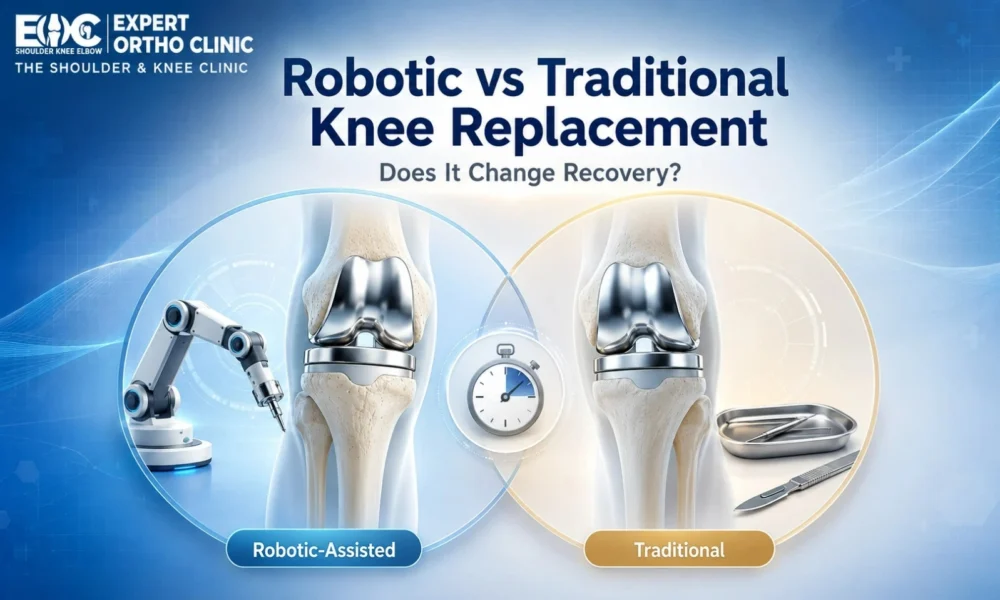
Robotic-assisted knee replacement has become more common, and it genuinely improves the precision of implant alignment, which can translate into a slightly smoother, faster early recovery for some patients. But it’s not a shortcut around the fundamentals – you’ll still go through the same physiotherapy stages, the same milestones, and the same overall timeline broadly. The choice between robotic and traditional, or partial versus total knee replacement, should come down to your specific joint condition and your surgeon’s assessment, not a general assumption that one guarantees an easier recovery than the other.
When to Call Your Surgeon During Recovery
Most of what you’ll feel during recovery is normal, even when it’s uncomfortable. But a few signs are worth calling about right away rather than waiting: fever, calf pain or swelling that could suggest a blood clot, wound discharge or redness spreading around the incision, or a sudden sharp increase in pain that feels different from your usual soreness. If you’re ever unsure, it’s always better to check than to wait it out – send a message or call rather than second-guessing yourself.
Frequently Asked Questions
What does recovery really look like after knee replacement?
It’s gradual and uneven – hard in the first two weeks, noticeably better by six weeks, mostly settled by three to six months, and still quietly improving for up to a year. Years later, most people forget they even have an implant, aside from occasional clicking or difficulty kneeling.
Is knee replacement recovery painful?
Yes, especially in the first two weeks, though it’s well managed with medication and eases significantly after that. Pain during physiotherapy exercises is expected and different from pain at rest, which should be much more controlled.
How long until I feel normal after knee replacement?
Most patients feel largely like themselves by three to six months, with full recovery and optimal strength taking up to a year.
What can’t you do after a knee replacement?
High-impact activities like running or contact sports are best avoided long-term. Deep kneeling and prolonged squatting may remain difficult for some patients indefinitely.
What is the hardest week after knee replacement?
For most patients, it’s week one to two, largely because of disrupted sleep and the discomfort of early physiotherapy.
Do you ever feel completely normal again after knee replacement?
Most people do, eventually. A smaller number notice a subtle awareness of the implant long-term, particularly with clicking sounds or kneeling – neither of which usually signals a problem.
Can you kneel 10 years after a knee replacement?
Some patients can, comfortably. Others find it uncomfortable indefinitely. It varies by individual and is worth discussing with your surgeon if kneeling matters to your daily life.
What happens years after a knee replacement?
For most, life continues normally with an implant that performs well for two decades or more. A minority eventually need a revision surgery if the implant wears or loosens over time.
How long does a knee replacement last?
Modern implants commonly last 20 years or more, depending on activity level, weight, and bone health.
Is a squatting-style Indian toilet manageable after knee replacement?
It requires more knee flexion than most patients comfortably regain, especially in the first year. A raised commode or Western-style seat is generally the more practical long-term choice for most patients.
About the Author
Dr. Sanjay Singh
MBBS, DNB Ortho, Diploma Ortho, Fellowship in Shoulder & Elbow Surgery (Italy)
Dr. Sanjay Singh is an arthroscopic and sports injury specialist practicing in Mumbai, with a focused expertise in keyhole (arthroscopic) surgery of the shoulder and knee. He received his foundational orthopedic training at the prestigious PGIMS, Rohtak, Haryana, followed by his DNB in Mumbai.
During his residency, Dr. Singh developed a particular interest in the subspecialty of arthroscopic shoulder and knee surgery. He went on to work as a Registrar at TNMC & Nair Hospital, where he spent a year sharpening his skills as an orthopedic surgeon. To deepen his expertise in arthroscopy, he traveled to Italy for specialized fellowship training in shoulder and elbow surgery, working alongside a team of highly skilled specialist surgeons across Europe and gaining significant experience managing complex shoulder and elbow conditions.
Today, Dr. Singh practices at Expert Ortho Clinic, with locations in South Bombay, Chembur, and Ghatkopar, where he treats a wide range of conditions including ACL and meniscal injuries, recurrent shoulder dislocation, rotator cuff tears, frozen shoulder, and both knee and shoulder replacement surgery, including robotic knee replacement. His approach is described by patients as conservative-first – favoring physiotherapy and exercise-based recovery where possible, with surgery reserved as a considered next step rather than a first resort.
Conclusion
Recovery from knee replacement is a real process, not a single moment. It has hard weeks and genuinely good ones, and it looks different in a Mumbai home than it does in a hospital brochure written elsewhere. Knowing what’s actually ahead – the sleepless nights in week one, the clicking sound five years later, the honest answer about kneeling – makes the whole journey easier to walk through, quite literally.
If you’re preparing for surgery or already recovering and have questions specific to your situation, you can WhatsApp your MRI report to Dr. Sanjay Singh for an opinion, or book a consultation at our South Bombay, Chembur, or Ghatkopar clinics. You don’t have to figure this out from a checklist alone.
For More Info Contact us


Gout: Symptoms Causes and Treatment
What is Gout? Gout is arthritis & joint pains caused by the deposition of uric acid within the joints most.
Read More
The Silent Threat: What you need.
What are Tendons? Tendons are rope-like structures that allow a muscle to condense & attach to a bone making it.
Read More